 TR
TR DE
DE EN
ENWhat is Sadaqah? In short, any good deed done for the sake of Allah without expecting anything in return; even a smile counts as Sadaqah.
In this article you will find the types of Sadaqah, its virtues in the Qur'an and authentic hadiths, and examples of Sadaqah Jariyah, whose reward continues even after death.
- Sadaqah is a voluntary good deed given for the sake of Allah; not only money – every good deed is Sadaqah.
- Zakat is obligatory under certain conditions, whereas Sadaqah is a voluntary act of worship with no limit on amount or time.
- Sadaqah Jariyah is a lasting good deed whose reward continues even after death: a water well, a mosque, a Qur'an or an education scholarship, for example.
- At Austria Yetim Eli, Sadaqah starts from €10; a Qur'an donation from €3,50 and a water well from €500.
What does Sadaqah mean?
The word Sadaqah comes from the Arabic root “sidq” (truthfulness, loyalty).
Islamic scholars explain this link by saying that Sadaqah is a sign of the sincerity of a person's faith.
As a term, Sadaqah is material or non-material help given to those in need in order to earn Allah's pleasure.
In the Qur'an the word “Sadaqah” sometimes also includes Zakat (at-Tawbah 9/60); in everyday language, however, it mostly means a voluntary (nafl) donation.
What are the types of Sadaqah?
1. Voluntary Sadaqah
A donation given from the heart, with the amount and timing up to you. A meal for a poor person, school supplies for a pupil, medicine for a patient…
On our website a Sadaqah donation starts from €10; you decide the amount.
2. Obligatory Sadaqah: Fitrah
Sadaqat al-Fitr, i.e. Fitrah, is the obligatory Sadaqah that every Muslim who reaches Eid al-Fitr and owns the Nisab must give.
For its amount and timing, see our guide How much is Fitrah.
3. Fidyah and Kaffarah
Financial payments made to compensate for shortcomings in acts of worship such as fasting. Details for those unable to fast are in our article What is the Fidyah for fasting.
4. Sadaqah Qurbani
An animal sacrificed with the intention of being relieved from hardship, giving thanks for a blessing or warding off calamity. For the types of Qurbani, see our article Nadhr, Aqiqah and Shukr Qurbani.
5. Non-material Sadaqah: every good deed
The Prophet (pbuh) said: “Every good deed is Sadaqah” (Bukhari, Adab 33; Muslim, Zakat 52).
Another hadith says: “Your smile to your brother is Sadaqah” (Tirmidhi, Birr 36). Removing an obstacle from the road or saying a kind word also falls into this category.
6. Sadaqah Jariyah
Sadaqah whose reward keeps flowing even after the giver has passed away. We cover it in detail below.
The virtue of Sadaqah: verses and hadiths
Sadaqah in the Qur'an
- al-Baqarah 2/261: What is spent in the way of Allah is likened to a seed that grows seven ears, with a hundred grains in each ear; Allah multiplies it further for whom He wills.
- al-Baqarah 2/274: Those who spend their wealth in the way of Allah by night and by day, secretly and openly, have their reward with their Lord; no fear shall be upon them, nor shall they grieve.
- Al Imran 3/92: You will never attain “birr” (the perfection of righteousness) until you spend in the way of Allah from what you love.
Sadaqah in authentic hadiths
- “Sadaqah does not decrease wealth.” (Muslim, Birr 69)
- “Protect yourselves from the Fire, even with half a date.” (Bukhari, Zakat 10; Muslim, Zakat 66)
- “The giving hand is better than the receiving hand.” (Bukhari, Zakat 18; Muslim, Zakat 94)
These hadiths show that in Sadaqah it is the intention, not the amount, that counts: even a small donation is valuable.
Let your Sadaqah, starting from €10, become a meal on a family's table or a child's education.
Give SadaqahLasting WorksThe difference between Sadaqah and Zakat
| Zakat | Sadaqah | |
|---|---|---|
| Ruling | Obligatory for those who meet the conditions | Voluntary (nafl); Fitrah is obligatory |
| Amount | 2,5% of wealth (one fortieth) | Free |
| When | When one year has passed over wealth that has reached the Nisab | Any time |
| To whom? | The 8 categories in at-Tawbah 9/60 | Broader: relatives, neighbours, charities, lasting works |
You can find the conditions of Zakat in our article What is Zakat, and who can receive it in our guide Who can receive Zakat.
What is Sadaqah Jariyah?
“Jariyah” here means “flowing, continuing”.
Sadaqah Jariyah refers to lasting good works that people benefit from over a long time, so that their reward continues even after the giver's death.
It is based on this hadith: “When a person dies, their deeds come to an end except for three: ongoing charity, beneficial knowledge, and a righteous child who prays for them.” (Muslim, Wasiyyah 14)
Examples of Sadaqah Jariyah
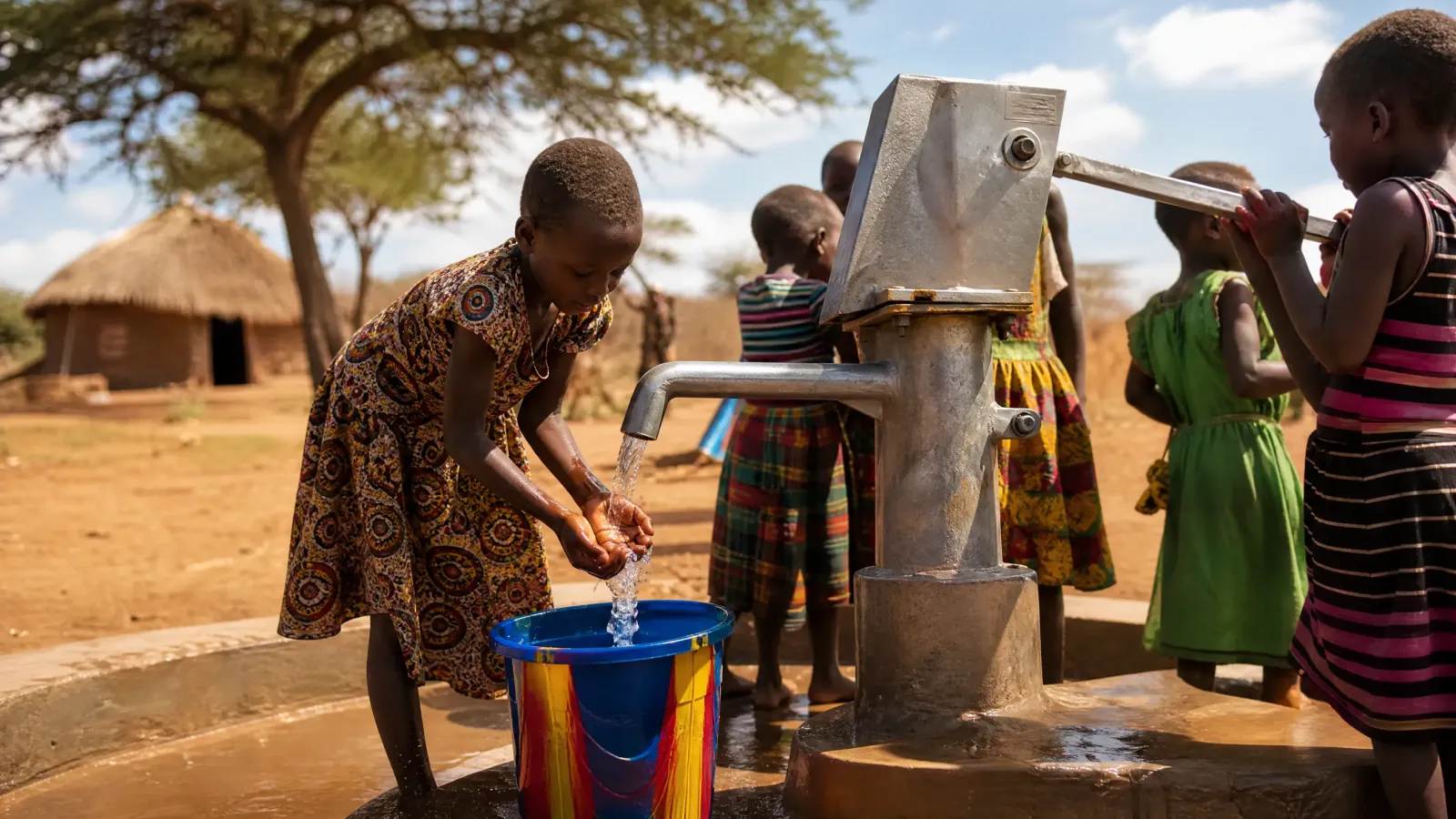
Water well: the most popular Sadaqah Jariyah
When Sa'd ibn Ubadah (ra) asked the Prophet which Sadaqah was most virtuous, he received the answer “Water” and had a well dug on behalf of his mother (Abu Dawud, Zakat 41).
Access to clean water is still vital today; the World Health Organization (WHO) stresses that unsafe water is one of the main causes of preventable diseases such as diarrhoea.
| Type of well | Example region | Donation |
|---|---|---|
| Hand-pump water well | Asia / Mali | 500 € / 2.000 € |
| Water well with ablution fountain (şadırvan) | Bangladesh | 1.500 € |
| Borehole water well | Benin | 6.000 € |
| Solar-powered water well | Yemen | 6.000 € |
You don't have to fund a well alone – you can also join in with a share. All options: water well projects · Detailed guide: water well donation.
Building a mosque
The Prophet said: “Whoever builds a mosque for the sake of Allah, Allah will build for him the like of it in Paradise” (Bukhari, Salat 65; Muslim, Masajid 24).
Complete mosque projects cost between €20.000 and €30.000 depending on the region; for example, building a mosque in Afghanistan costs €30.000. You can take part with shares starting from €100.
Qur'an donation
Every Qur'an that is read is regarded as beneficial knowledge and a lasting good deed.
A Qur'an donation is €3,50 (Afghanistan €5).
Student scholarships and education
Supporting a child's schooling counts as the “beneficial knowledge” mentioned in the hadith.
A student scholarship in Africa is €25 per month. For other projects, see the education projects page.
A means of livelihood: dairy goat
A dairy goat given to a family (Africa €100) provides milk and income for years, creating lasting benefit.
Caring for an orphan
Supporting an orphan's long-term care and education is also among the lasting good deeds. Orphan sponsorship is €50 per month; details in our article orphan sponsorship.
Example calculation: a lasting work from small monthly Sadaqah
Example scenario: A family living in Salzburg sets aside €25 for Sadaqah every month.
- Amount saved over 1 years: 12 × €25 = €300.
- With this amount, 3 mosque shares (3 × €100) could be bought,
- or 85 copies of the Qur'an (85 × €3,50 = €297,50) could be donated,
- or, by saving for 20 months (20 × €25 = €500), a hand-pump water well could be built in Asia.
Small but regular Sadaqah turns into a lasting work over time.
The wisdom of Sadaqah: for the giver, the receiver and society
Sadaqah benefits not only the person in need but also the one who gives.
- For the giver: It purifies wealth from stinginess and greed and strengthens gratitude.
- For the receiver: Their basic needs are met and a dignified life is supported.
- For society: It narrows the gap between rich and poor and increases solidarity and trust.
For a Muslim living in Austria, Sadaqah is also a tangible bond with their brothers and sisters far away.
Behaviours that nullify the reward of Sadaqah
The Qur'an clearly warns that Sadaqah can be wasted through certain behaviours.
In verse 264 of Surah al-Baqarah, believers are commanded not to nullify their Sadaqah by giving it with reminders of generosity and hurtful words.
- Reminding others of your generosity: Bringing up the favour you did or expecting something in return.
- Showing off (riya): Giving so that people will see, instead of for the sake of Allah.
- Giving from poor-quality wealth: Giving things that are unusable and that we would not accept ourselves (al-Baqarah 2/267).
That is why Sadaqah should be given quietly, expecting the reward from Allah alone.
How and to whom should Sadaqah be given?
- Close circle first: Relatives and neighbours in need come first; Sadaqah to relatives is both Sadaqah and upholding family ties (silat ar-rahim).
- Discretion: It is recommended to give away from show and, if possible, in secret.
- Halal earnings: Sadaqah should be given from halal wealth.
- Trustworthy intermediary: For Sadaqah sent abroad, choose a trustworthy organisation. See our guide choosing a trustworthy charity.
From Austria you can give your Sadaqah by Card / Online (Visa, Mastercard, Apple Pay, Google Pay, EPS) or PayPal, and combine several projects in one basket. To see the place of Sadaqah in Ramadan, take a look at our Ramadan donation guide.
Start your Sadaqah Jariyah today with a water well, a mosque share or a Qur'an donation.
Donate a Water WellGive SadaqahFrequently Asked Questions
Are Sadaqah and Zakat the same thing?
No. Zakat is an obligatory act of worship: 2,5% of wealth that has reached the Nisab and been held for one year. Sadaqah, on the other hand, is a voluntary donation whose amount and timing are up to you.
Which Sadaqah is the most virtuous?
The hadiths praise Sadaqah given where the need is greatest; giving water is mentioned in particular (Abu Dawud, Zakat 41). Sadaqah Jariyah, whose reward continues, also carries great virtue.
What are examples of Sadaqah Jariyah?
A water well, a mosque, donating a Qur'an, a school, a student scholarship – any work that people benefit from over a long time is Sadaqah Jariyah.
Can Sadaqah be given on behalf of someone who has passed away?
Yes. Sadaqah and Sadaqah Jariyah can be given on behalf of deceased parents or relatives; simply state on whose behalf it is when you donate.
How many euros should Sadaqah be?
There is no set amount for Sadaqah. On our website Sadaqah starts from €10 and a Qur'an donation is €3,50; what matters is intention and sincerity.
Can Sadaqah be given to one's parents?
Voluntary Sadaqah may be given to parents and relatives in need. Zakat and Fitrah, however, may not be given to parents, children or one's spouse.
Sources: Diyanet — Tafsir of Surah al-Baqarah, verse 261 · TDV İslâm Ansiklopedisi — Sadaka · WHO — Drinking-water

Based in Innsbruck, Austria Yetim Eli is a humanitarian aid association founded under Austrian association law. The religious information in our articles is based on sources published by the Diyanet (Turkish Presidency of Religious Affairs); field information comes from the regions where our teams work. If you have any questions, write to us or reach us on WhatsApp. Who are we? · Board